What is your height?
Slide to set your height accurately.
Why Your Height Is the Foundation of Your Health Calculation
When it comes to understanding your body and your health, height is one of the most fundamental measurements you can take. It’s not just a number on your driver’s license or something you get measured at a doctor’s office once a year — your height is the very foundation on which your entire BMI calculation is built.
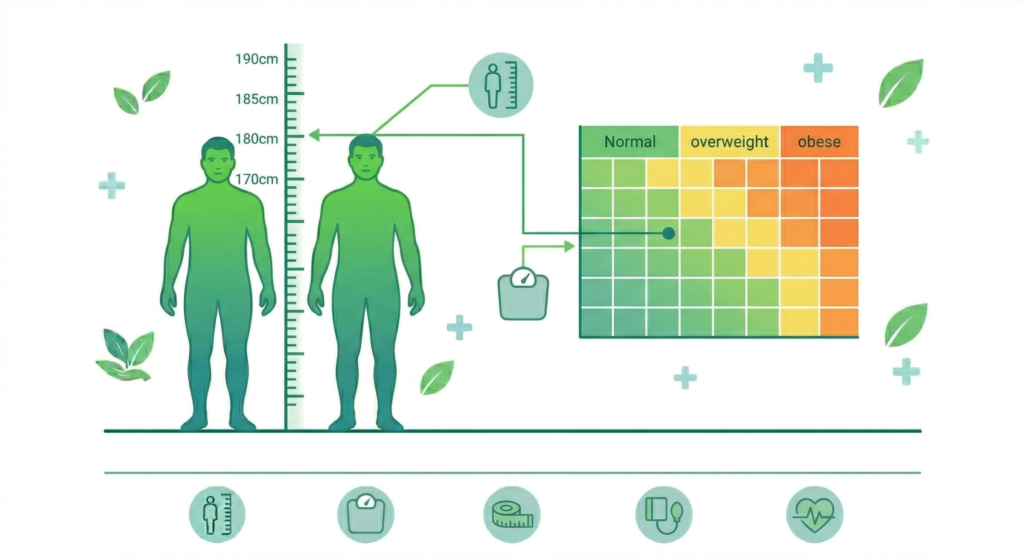
What Does Height Have to Do With Health?
At first glance, height might seem like something completely out of your control — you are born with certain genetics, you grow to a certain point, and that’s it. And while that’s mostly true, understanding your height in relation to your weight tells you something incredibly important about your body.
BMI exists precisely because weight alone means nothing without height. A person who weighs 90 kg might be perfectly healthy if they are 6 feet tall, but could be significantly overweight if they are only 5 feet tall. Height gives your weight context — and that context is everything.
How Height Is Used in BMI Calculation
The BMI formula divides your weight in kilograms by your height in metres squared. This means height has an outsized effect on your final BMI number compared to weight.
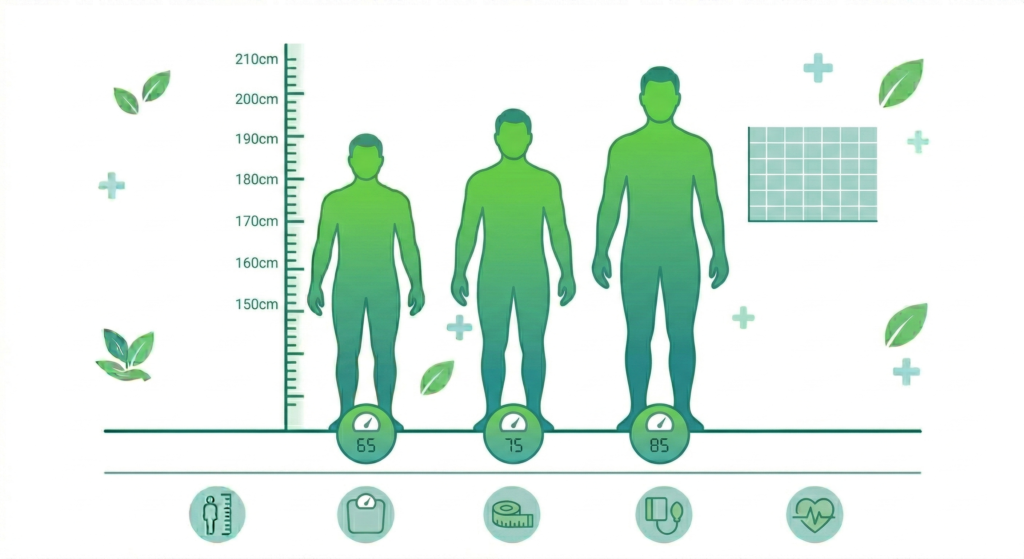
For example, consider two people who both weigh 75 kg:
A person who is 160 cm tall will have a BMI of 29.3 — which falls in the overweight category.
A person who is 175 cm tall will have a BMI of 24.5 — which falls perfectly in the normal healthy range.
Same weight, completely different health picture — just because of a 15 cm difference in height. This is why measuring your height accurately is so important before calculating your BMI.
How to Measure Your Height Correctly
Most people haven’t measured their height properly since school. Here’s how to do it right at home:
Stand with your back flat against a wall. Make sure your heels, buttocks, shoulders and the back of your head are all touching the wall. Look straight ahead — not up or down. Have someone place a flat object like a book on top of your head and mark the wall. Measure from the floor to that mark.
A few common mistakes people make:
Standing with shoes on — always measure barefoot. Slouching or leaning — posture matters more than you think. Measuring in the evening — you are actually slightly shorter at the end of the day because your spinal discs compress slightly throughout the day. Morning measurements are most accurate.
Does Height Change Over Time?
Yes — and this surprises many people. You reach your maximum height sometime in your late teens or early twenties. After that, height remains stable for most of adulthood.
However, after the age of 40, most people gradually lose height — typically around 1 cm per decade. This happens because the discs between your spinal vertebrae slowly lose fluid and compress over time. Bone density loss, especially in women after menopause, can accelerate this process and lead to more noticeable height reduction.
This is important because if you are using your height from ten or twenty years ago in your BMI calculation, you might be getting a slightly inaccurate result. Always measure your current height for the most accurate BMI.
Height and Health Risks
Beyond BMI, height itself has some interesting connections to health that researchers have uncovered over the years.
Taller people generally have a lower risk of heart disease. This may be partly because taller individuals tend to have larger lung capacity and better cardiovascular efficiency.
However, taller people have a slightly higher risk of certain cancers, possibly because they have more cells in their body that could potentially mutate over a lifetime.
Shorter individuals may have a higher risk of type 2 diabetes and metabolic syndrome, though lifestyle factors play a much bigger role than height alone.
These are statistical associations — not certainties. Your height is not your destiny. What you do with your body every day matters far more than how tall you are.
Height and Ideal Weight Range
One of the most useful things that comes out of your BMI calculation is your ideal weight range — and this is entirely based on your height. The taller you are, the wider your healthy weight range becomes.
For a person who is 160 cm tall, the healthy weight range is roughly 47 to 64 kg.
For a person who is 175 cm tall, the healthy weight range expands to roughly 57 to 76 kg.
For a person who is 190 cm tall, the healthy weight range is approximately 67 to 90 kg.
Knowing your ideal weight range gives you a clear, realistic target — not some generic “lose weight” advice, but an actual number to work toward based on your unique body.
cm or Feet — Which Should You Use?
Our calculator lets you enter your height in either centimetres or feet and inches — whichever feels more natural to you. Centimetres are used in most of the world and in medical settings, while feet and inches are more common in the United States and a few other countries.
Either way, the calculation behind the scenes converts everything to the same unit, so your result will be equally accurate regardless of which measurement system you prefer.
Stand Tall, Know Your Numbers
Your height is something you were given — but what you do with the body that carries that height is entirely up to you. Knowing exactly how tall you are, and how that relates to a healthy weight for your frame, is one of the simplest and most empowering pieces of health knowledge you can have.
Enter your height accurately in the next step, and let the calculator do the rest. A clear, personalised health picture is just a few seconds away.